
- Sourcing CNC machining? The test is not the tolerance printed on a brochure — it is whether the shop can hand you a CMM report for the exact feature you are buying, with the band, the sample size and the study window all named.
- What CNC machining is: a subtractive process — a cutter removes material from a workpiece along a programmed toolpath until the geometry, tolerance and surface finish on the drawing exist.
- 100+ production machines — Mazak / Brother / Tsugami / Star / Citizen class, across a 6,800 m² facility (3-axis 50+, 4-axis 20+, 5-axis 20+, 25+ lathes, 7+ grinders, 20+ inspection instruments).
- Tolerance: ±0.003 mm, turning ±0.002 mm, grinding ±0.002 mm — verified on Hexagon CMMs. Capability is reported per characteristic: Ppk ≥ 1.67 in the initial study and Cpk ≥ 1.33 in production on key and special characteristics (≥ 1.33 on general characteristics). Every report names the feature, its tolerance band, the sample size, the sigma method, and the study window.
- Three certificates — ISO 9001:2015, IATF 16949:2016 (design excluded) and ISO 14001:2015, all held by Dongguan Zhuohang Ltd, the entity that invoices you.
- Order terms: MOQ 1 piece, lead times of roughly 3 / 7 / 30 days depending on complexity.
What is a machining manufacturer?
A machining manufacturer is a company that owns the machines, the floor and the quality system that make the parts, not a broker that forwards drawings. This Dongguan manufacturer runs 100+ machines on 6,800 m², holds ISO 9001:2015 and IATF 16949:2016, and has operated since 2005. What it controls — capacity, processes, inspection — is what its lead-time promises are built on.
CNC machining is the subtractive manufacturing of parts on computer-numerically-controlled milling, turning, and grinding equipment. A cutter removes material from a workpiece along a programmed toolpath to produce a part that meets a drawing-defined geometry, tolerance, and surface finish. "CNC" means the tool path is numerically controlled rather than hand-operated.
The rest of this guide turns that definition into a buyer's checklist for this shop — what to verify before you commit, and how the numbers on the drawing actually reach the part.
The discipline separates into milling (the cutter rotates and the workpiece is fed; prismatic geometry), turning (the workpiece rotates and the tool is fed; rotational geometry), and precision grinding / wire EDM (the tightest tolerances on critical features). A plant that produces CNC machined parts end-to-end runs all three.
The output of CNC machining is a part that meets the drawing — geometry, tolerance, surface finish, and material certificate — and is documented to a quality plan (FAI for general work, PPAP for automotive-bound parts, IMDS for material data). That is the answer to "what is CNC machining": a numerically-controlled subtractive process that produces a part to a drawing, with the quality documentation that lets the part enter an assembly.
- Lead time is set by process steps, not by a slogan. Roughly 3 days for simple parts, 7 for standard, up to 30 for complex parts with 10–20 steps or surface finishing.
- MOQ 1 piece — you validate a design and prove the schedule before committing to volume.
- a floor of 100-plus machines across milling, turning, mill-turn, and grinding on a 6,800 m² floor staffed by 100+ people. ±0.003 mm CNC milling, ±0.002 mm CNC turning tolerance, ±0.002 mm grinding, verified on Hexagon CMMs.
What Does a Machining Manufacturer Actually Control?
The word "manufacturer" matters because it is the difference between a supplier that owns its schedule and one that borrows someone else's. A machining manufacturer runs the machines on its own floor, employs the programmers and machinists who run them, and answers directly when a batch is late or a dimension drifts. A reseller, by contrast, brokers your order to a factory it can swap at will, which means the delivery date you were quoted is a guess about a third party's workload.
For you who cares about on-time delivery, that ownership is the whole game. When one party owns the machines, the material, and the inspection bench, the lead time it quotes is a plan it can defend. When the order passes through a middleman, the date is a hope. The rest of this page is about how to tell which one you are dealing with, and how to read the numbers behind a delivery promise.
Here is a two-question test you can run in a single email. Ask for the street address of the shop floor and the certificate number of the ISO registration. A manufacturer answers with a building and a number you can check against the registrar's database; a middleman answers with a city and an assurance. The test works because a factory is anchored in place — it owns machines that cannot be swapped overnight, and a certificate number tied to a real building. A broker owns neither, which is why its delivery date drifts the moment the order changes hands.
How Much Capacity Does a Machining Manufacturer Actually Have?
Capacity is the raw material of a delivery date. Before you believe any lead time, ask what sits behind it: how many machines, of what kind, on how much floor, staffed by how many people. The answer tells you whether the shop can absorb your order or will bury it under the ones that came before.
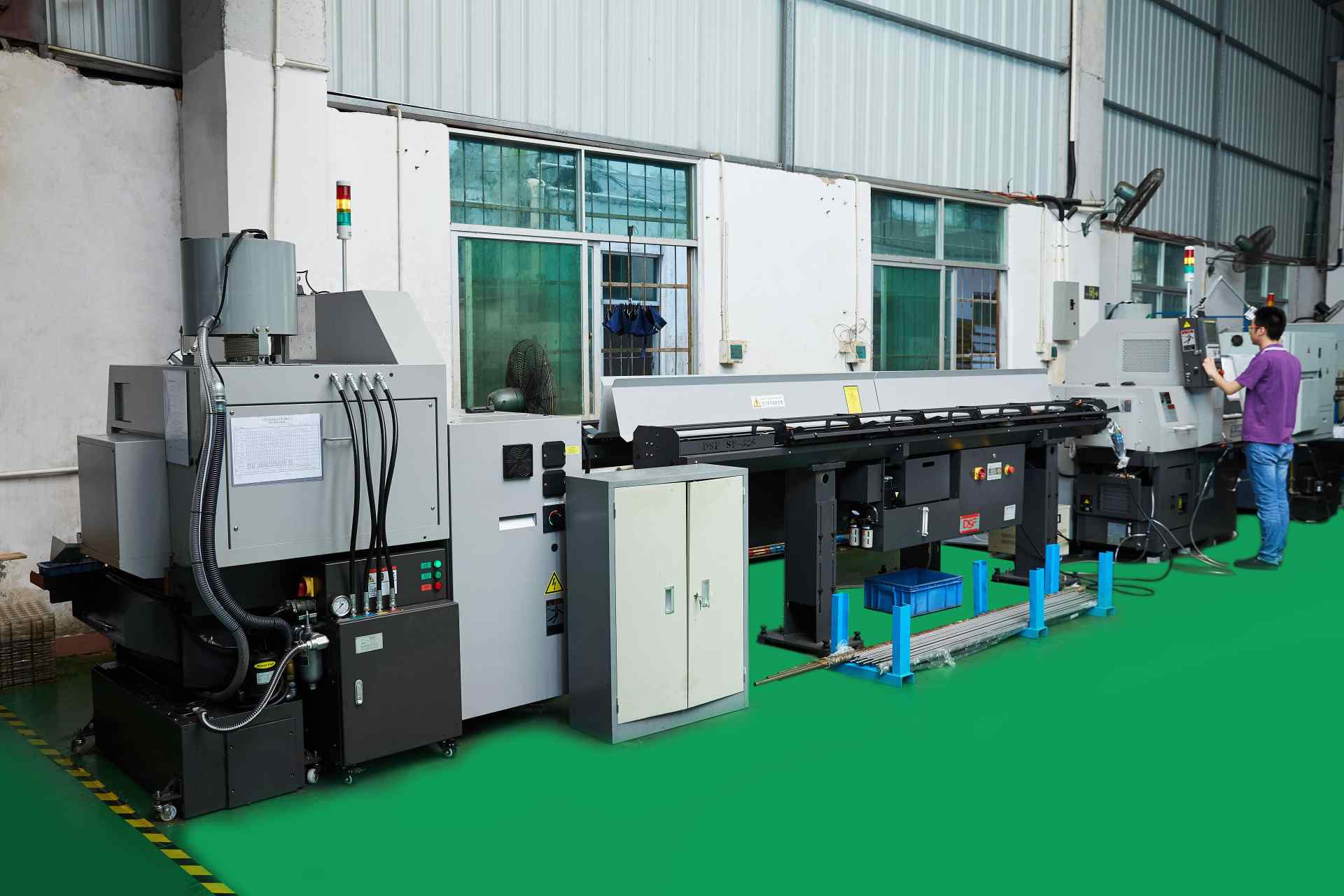
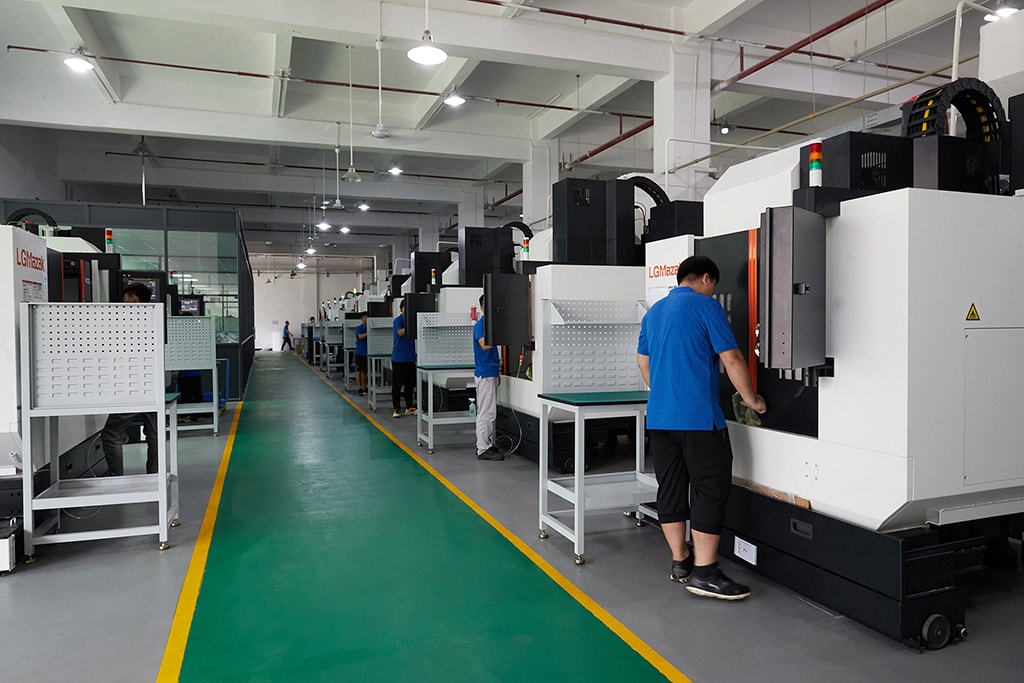
Our floor runs 100+ production machines across the full metal-cutting range — 3-axis (50+), 4-axis (20+), and 5-axis (20+) milling centers, 25+ CNC lathes, mill-turn centers, and 7+ grinders — inside a 6,800 m² facility staffed by 100+ people, of whom 80% are skilled technicians. The company has served 100+ customers across automotive, robotics, electronics, medical, and automation equipment, with an annual output of 1,000,000+ pieces.
Two details in those numbers matter more than the totals. First, the mix — a part that needs milling, turning, and grinding can be completed under one roof instead of being shipped between subcontractors. Second, the redundancy — with 50+ 3-axis centers, a single machine down for maintenance does not stall your delivery. Capacity is not just size; it is the number of ways the same part can get made on schedule.
The numbers are claims until you check them, and the check is cheap. A live walk-through — a video call aimed at a running machine, not a catalog photo — confirms that the a hundred-odd machines are real and running. Ask for a machine list with model names and quantities; a manufacturer keeps one, a reseller does not. Then ask the follow-up that separates size from slack: how many of those machines are redundant for the operations your part needs. Fifty interchangeable 3-axis centers absorb a rush; a single 5-axis machine that is already booked does not, however impressive the brochure.
Why Do Lead-Time Promises Fail, and How Do You Tell?


Most late deliveries are not caused by a factory that lied; they are caused by a factory that quoted without looking at the schedule. A real lead time is the output of three inputs: how many process steps the part needs, whether any of those steps are outsourced, and what is already queued on the relevant machines. A salesperson who quotes "two weeks" without checking those three things is not promising a date — they are hoping for one.
The tell is in the follow-up questions. Ask a supplier which machines will run your part, how many operations it passes through, and which steps — anodizing, plating, heat treatment — leave the building. A machining manufacturer answers with specifics: "five operations, turned then milled then deburred, anodizing at our partner adds four days." A reseller answers with a round number and a promise. Specifics are a schedule; round numbers are a gamble.
There is a second, quieter way a date dies: the hidden step. A part that needs a material the shop does not stock waits for procurement before the first chip. A part that needs a fixture the shop must build waits for tooling. A part that needs a finish the shop outsources waits for someone else's queue. Each is a step the buyer never saw, and each adds days that were never in the promise. The fix is the same in every case — demand a lead time that names its steps, and treat any step you cannot name as a risk rather than a detail.
Rule of thumb: a lead time you can defend is one that names its steps. If the quote does not tell you why the part takes that long, you have not been given a date — you have been given a placeholder.
What Do the 3 / 7 / 30-Day Lead-Time Tiers Mean in Practice?
Rather than quote a single misleading number, we price delivery in three tiers tied to how much work the part actually is. The tier is set by complexity and process count — the more operations a part needs, the longer it takes, and any surface finishing pushes it into the longer tier.
| Tier | Approx. lead time | Typical profile |
|---|---|---|
| Simple | ~3 days | Few operations, single material, no finishing, standard tolerance |
| Standard | ~7 days | Multiple operations, standard tolerances, common alloys |
| Complex | ~30 days | 10–20 process steps, tight tolerances, or surface finishing / heat treatment |
Two honest qualifications come with those tiers. First, a complex part can run 10–20 process steps, and each step is a day of setup, cutting, or waiting at a secondary operation. Second, anything that leaves the building — plating, anodizing, outsourced heat treatment — adds time you should see reflected in the quote, not discover later. Tell us your target date and we will tell you whether it holds.
The arithmetic behind the tiers is worth seeing once, because it is what makes a date honest. A simple part spends about a day on programming and setup and a day cutting and inspecting — three days in total. A standard part spreads the same work across several operations, each with its own setup, so it lands around seven. A complex part with 10–20 steps is not simply ten times longer; it accumulates queue time between operations, plus the days of any finishing that leaves the building. When a shop quotes three numbers instead of one, it is showing you the work, and a date built on work is a date you can hold.
What Does Material Choice Do to a Quoted Lead Time?
Material is the quiet variable in most delivery dates, because it acts twice — once before the cut and once during it. Before the cut, the question is availability: common alloys sit on the shelf and start the same day, while an uncommon grade waits for its own procurement lead time. During the cut, the question is machinability: free-machining alloys run fast, while hard or gummy grades force slower feeds, more tool changes, and more time on the spindle.
If you name the alloy precisely — "6061-T6," not "aluminum" — you give the shop the one fact it needs to quote a real date instead of a placeholder. The table below shows how the common families behave against the schedule.
| Material family | Typical grades | Availability | Effect on the schedule |
|---|---|---|---|
| Aluminum | 6061-T6, 7075-T6, 5052 | Usually in stock | Fast cutting, short spindle time |
| Stainless steel | 303, 304, 316 | Usually in stock | Slower than aluminum; 303 is the free-machining choice |
| Carbon / alloy steel | 1018, 1045, 4140 | Readily available | Steady cutting; hardening adds a step |
| Brass / copper | C360, H62, C110 | Usually in stock | Fast cutting, good for electrical parts |
| Titanium | TC4, TA2 | Often special order | Slow cutting; stress relief may be outsourced |
The availability half of the table is the one buyers underestimate. A part drawn in an exotic alloy may machine fine, but if the stock is not already on the floor, the procurement lead time runs before the first chip, and that lead time is invisible unless you ask about it. State the alloy, then ask whether it is in stock; the answer to the second question is often the real delivery date.
Where the choice itself is between aluminum and stainless — the most common material decision a machined part forces — your decision table in the guide to aluminum vs stainless runs the weight, corrosion, stiffness, cost, and schedule axes one row at a time.
How Do Tolerances and Surface Finish Steer the Schedule?
Tolerance and finish are the two levers that most directly buy time, or waste it. A tight tolerance is not free: it slows the cut, adds inspection, and raises the scrap rate on every dimension it touches. A surface-roughness call-out does the same downstream, because the finer the Ra, the more finishing operations the part needs.
your rule is selective tolerancing — put the tight numbers only where they control function, and let everything else ride at a general standard. The two tables below show the cost of each increment.
| Process | Held tolerance | Schedule cost |
|---|---|---|
| CNC milling | ±0.003 mm | Fast when toleranced selectively |
| CNC turning | ±0.002 mm | Standard for round parts |
| Precision grinding | ±0.002 mm | Adds a finishing operation and its own lead time |
| Roughness (Ra) | Typical finishing route | Schedule effect |
|---|---|---|
| 3.2 µm | As-machined | No added time |
| 1.6 µm | Fine turning / milling or light finishing | Small added step |
| 0.8 µm | Grinding, honing, or lapping | Adds a finishing operation |
| 0.4 µm | Fine grinding / lapping / polishing | Meaningful added lead time |
For dimensions left un-toleranced on the drawing, a general tolerance standard is what keeps the print unambiguous. ISO 2768 defines coarse (c), medium (m), and fine (f) classes for linear and angular dimensions, and naming the class — "ISO 2768-m" — tells the shop which general band applies to the features you did not dimension. That single note removes the most common source of ambiguity between buyer and shop, and ambiguity is where schedule surprises come from.
How Does a Factory Ramp Production as Your Volume Grows?
The scariest moment in your relationship with a supplier is the ramp — the jump from 50 parts a month to 5,000, or from a prototype to a production run. A shop that quotes a lovely prototype lead time and then collapses under volume is a familiar story. The protection against it is a factory that designed for the ramp from the start.
That is what a 1-piece MOQ is really for. It means the path from first article to full production stays on the same floor, with the same programmers, the same tooling philosophy, and the same inspection bench, so the part you approved at one piece is the part that ships at ten thousand. It also means you can test the schedule honestly: run a small batch, watch the dates, and only then commit volume.
The capacity math supports it. With 100+ machines spanning several families and an annual output of 1,000,000+ pieces, a growing program is absorbed by adding shifts and machines rather than by shoehorning your work into someone else's queue. A ramp should feel like turning a dial, not like starting over with a new supplier.
A ramp is decided long before the first production order, in how the part was designed for manufacturability. A part that can be fixtured once, cut in a single clamping, and measured with a standard gauge scales cleanly; a part that needs a bespoke fixture and a hand-finish step scales painfully. The cheapest time to think about the ramp is at the drawing, not at the volume increase. A manufacturer that raises those questions in the first-article review is protecting your ramp; one that never mentions them is selling you a prototype date as if it were a production date.
How Does a Machining Manufacturer Handle Peaks and Quiet Seasons?
Every factory has a busy season and a slow one, and if you only ever order at the peak, you learn the hard way which suppliers break under load. The question to ask is not "are you busy now?" but "how do you behave when you are?" A manufacturer with real capacity and a real scheduling system can tell you, in advance, that a September order will take six days instead of five, and then hit six.
The discipline that makes this possible is planning, not heroics. When a machine list has redundancy — 50+ 3-axis centers, 25+ lathes — a surge in one product line does not have to displace every other order. When a factory knows its process-step counts, it can forecast how much load a new order adds. And when it answers a quote request within 30 minutes and can turn a simple part in as little as 1 day, it has the slack to absorb a rush without dropping the ball on the orders already in the queue.
What to ask in October: "What is your current lead time, and how does it shift if I double the quantity?" A manufacturer that can answer that with numbers is one whose peak-season promises you can actually bank.
The opposite failure is the quiet season, and it is just as informative. A factory that sits empty in its slow months has either lost customers or never had them; a factory that uses the quiet months to pre-stage stock, service machines, and train people is one that will still be capable when your peak arrives. Ask a supplier what its slow season looks like and what it does with it. The answer tells you whether the shop runs on planning or on adrenaline, and only one of those survives a demand spike.
How Does Scheduling Many Part Numbers Affect Your Delivery Date?
Most buyers order one part at a time and imagine the factory works on nothing else. The reality is a machining manufacturer is always running a portfolio — dozens of part numbers, each with its own material, setup, and tolerances, competing for the same machines. Your delivery date is not a queue position; it is the answer to a scheduling problem.
That problem has three levers. Machine availability — is there a mill free, or is your part waiting behind three others? Setup time — a part that needs a new fixture and program costs the shop a morning, and that morning shows up in your date. Material arrival — an alloy that is not in stock has a procurement lead time that runs before the first cut. A machining manufacturer that plans around all three can quote you a date it keeps; one that treats your order as a first-come queue is already late and does not know it yet.
your lever is information. When you send a drawing that says what the part is, what alloy, how many, and what finish, the shop can place you in the schedule accurately. When you send a vague part and a wish, the schedule returns a vague date, and vagueness is where lateness lives.
The scheduling problem also explains why two identical-looking orders get different dates. A part that reuses an existing fixture and a proven program slots into the queue in hours; a part that needs new tooling and a first-run program consumes a morning of setup before it earns a single chip. When you ask for a date, the scheduler is pricing your part's setup cost, not just its cutting time. That is why repeat parts ship faster than new ones, and why a manufacturer that asks "is this a repeat or a first run?" is doing its job rather than being difficult.
What Standard Engineering References Anchor a Defensible Date?
A defensible delivery date is built on references both parties can look up, not on a salesperson's optimism. Four families of standard references do most of the work: general tolerance classes, public material properties, design-for-manufacturing rules of thumb, and Incoterms for shipping.
Start with the design rules, because a part that respects them spends less time being reworked. The table lists the rules that most often keep a job on schedule.
| Design rule | Practical guidance | Why it protects the schedule |
|---|---|---|
| Wall thickness | Keep thin walls above the material's minimum for stiffness | Prevents chatter and rework |
| Hole depth | Limit depth to roughly 4–5× the diameter | Avoids broken tools and re-drilling |
| Internal radii | Match the radius to a standard cutter size | Removes a re-fixture or EDM step |
| Tapped threads | Keep holes within standard tap limits | Avoids hand-tapping and scrap |
Material properties that affect machinability are public data, and you can sanity-check a schedule against them. 6061-T6 aluminum machines quickly and is the default for general housings; 7075-T6 is stronger but slightly less forgiving; 5052 is chosen for forming and corrosion resistance. 304 stainless is the corrosion workhorse but cuts slower than 303, the free-machining grade; 316 adds molybdenum for chemical resistance. 4140 alloy steel machines steadily in its normalized state and is hardened after machining when the drawing calls for it.
Hardness is the number that best predicts how a material will behave on the spindle, and it is published for every common grade. A soft aluminum cuts easily and spares the tool; a hardened steel demands slower feeds and more tool changes; an annealed stainless runs far better than one in a work-hardened condition. You do not need to know the exact value — only that the condition matters, which is why an RFQ that names the temper, such as "6061-T6," produces a far more accurate date than one that names only the alloy.
On the shipping side, the Incoterms label defines where the factory's responsibility ends and your begins. EXW hands the goods over at the factory gate, FOB at the port of origin, and DAP at the destination. Knowing the term keeps "delivery date" honest: an EXW date means the parts are ready at the dock, not on your receiving floor, and the transit time beyond that point is a separate, buyer-controlled leg. A clear term is part of a clear schedule.
Where Does Lead-Time and Capacity Verification Fail?
Verification fails most often not because a supplier lies, but because you ask questions that are easy to answer. "What is your lead time?" invites a number; "show me the schedule behind the number" demands evidence. Three failure modes show up again and again.
- The round-number quote. A lead time of "two weeks" with no mention of steps, material, or finishing is a placeholder, not a plan.
- The capacity claim with no redundancy. A shop that lists machines but cannot say which ones run your part, or how many are interchangeable, is quoting size without slack.
- The missing outsourced step. If a quote does not name plating, anodizing, or heat treatment, assume the step exists and is unquoted — then ask.
Each of these fails the same test: it does not connect the date to the work. A supplier that cannot connect them is not necessarily dishonest, but it is unverified, and an unverified date is a risk you are carrying, not the factory.
How Does Capacity Verification Play Out Across Industries?
Different industries stress different parts of the same capacity question, and a manufacturer that serves several has seen the failure modes of all of them. Three examples show how the same floor answers three different demands.
An e-bike drivetrain program is a seasonal business. Orders spike ahead of the riding season, so the schedule must flex without displacing other customers — a pure test of peak-season redundancy, and exactly the 50+ 3-axis centers and 25+ lathes question from earlier. A medical device program is the opposite: small lots, tight tolerances, and full traceability from the material certificate to the CMM report, which tests the quality system more than the machine count.
A robotics program sits in between. It mixes large structural parts with small precision shafts on the same floor, which tests whether a shop can schedule a portfolio without starving either end. A manufacturer that can point to all three — seasonal volume, regulated small lots, and mixed-part portfolios — has been stress-tested by the market, not just by its own brochure. When you verify capacity, ask which of these three patterns your own program resembles, and check the answer against the machines and the quality records, not against a slogan.
How Do You Get an Honest Delivery Date Before You Order?
An honest date comes from an honest RFQ, and an honest RFQ has four parts. Send them together and the delivery date you get back is a plan; send them piecemeal and it is a guess.
- The geometry — a STEP or IGES file plus a 2D drawing with tolerances on the critical features only.
- The material — the exact alloy and condition: "6061-T6," not "aluminum."
- The finish — as-machined, anodized, plated, or coated; finish adds days and you should see them.
- The quantity — per order, and the annual volume if you know it, so the shop can plan for the ramp.
Then push on the date you get back. Ask which machines run the part, how many steps it has, and whether any step is outsourced. A machining manufacturer that answers those questions in specifics is giving you a schedule it can defend, and that is the only kind of delivery date worth writing into a purchase order.
The four fields do more than speed up quoting — they reveal the shop. A manufacturer reads them and comes back with a date plus a note about which step is the long pole. A reseller forwards them to someone else and returns a number. The difference shows up in the follow-up: ask which machine runs the part and how many steps it has, and the manufacturer answers while the middleman stalls. You are not interrogating a supplier when you ask this; you are reading a schedule the way its owner would.
What Belongs on your Due-Diligence Checklist?
Before you commit volume to a machining manufacturer, run a five-point check. Each point is cheap, each eliminates a class of risk, and together they separate a supplier you can scale with from one you are gambling on.
- Entity. The name on the invoice, the certificates, and the building should match — here, Dongguan Zhuohang Ltd
- Floor. Verify the more than 100 machines and 6,800 m² with a live walk-through or a video call aimed at a running machine.
- People and process. Ask for the skilled-technician ratio and a Cpk chart, not a capability statement.
- Records. Request a real CMM report and certificate numbers you can verify with the registrar.
- Schedule logic. Demand a lead time that names its steps, its material, and its outsourced finishing.
Run those five before you sign, and the delivery date in your purchase order becomes the output of a real factory rather than a brochure. That is the difference between a schedule you can plan a production line around and a promise you are hoping survives the first delay.
How Do You Read a Machine List, and What Should It Tell You?
A machine list is the most under-used verification document you can ask for, because it converts a capacity claim into something checkable. The list should name the machine type, the model, and the quantity, not just "CNC machines," but "3-axis vertical machining centers, 50+ units." If a supplier will not share the list, treat the capacity claim as unverified, because a real factory keeps one and a middleman does not.
Three things on the list matter more than the total count. The first is coverage — whether the list spans every operation your part needs, so it does not have to leave the building between steps. The second is redundancy — whether the operations your part needs appear on more than one machine, so a breakdown or a maintenance window does not stop the line. The third is condition — a modern list with maintenance records beats an impressive brochure of machines that may or may not still run.
Read the list the way a scheduler does, operation by operation. Count the machines your part actually touches: if it needs milling, turning, and grinding, and the list shows all three families with spare capacity in each, the date you are quoted has somewhere to live. If the list shows one mill and one lathe, the date lives or dies on two machines, and you should price that concentration of risk into your own plan.
The numbers behind this floor are the kind you can check. The mix spans 50+ 3-axis centers, 20+ 4-axis, 20+ 5-axis, 25+ lathes, and 7+ grinders, plus the inspection instruments that close the loop. That spread is what lets a part be completed under one roof, and it is what lets the shop tell you — machine by machine — where your order will run. A machine list is not a sales document; it is a map, and if you cannot get the map, you should question the destination.
How Do Regulatory and Regional Differences Shape a Delivery Date?
A delivery date is not only about the shop floor; it is also about where the part is going and what it does there. Different markets attach different documentation and compliance expectations to the same physical part, and those expectations add steps that show up in the schedule. If you know which regime your order falls under, you can plan for the paperwork instead of discovering it at the dock.
The general pattern holds across Europe, North America, Japan, Australia, and New Zealand: regulated industries — automotive, medical, aerospace — expect a certificate trail, while general industrial parts need far less. What shifts between markets is the emphasis, not the principle.
- Regulated industries (automotive, medical, aerospace) expect a full record: material certificates, process parameters, lot traceability, and inspection reports.
- General industrial parts need a leaner record — typically a material certificate and a dimensional report — which adds little to the schedule.
- Surface-treatment exports can trigger chemical and substance declarations that a domestic order does not need, and those documents take time to prepare.
- Export shipping adds documentation lead time — packing lists, commercial invoices, and freight documents — regardless of the end market.
The practical rule for you is to state the destination and the end use up front. A part headed for an automotive program carries IATF 16949 documentation expectations that a general industrial part does not; a part with a surface finish exported to a market with strict chemical requirements needs that requirement named at quoting, not at customs. Naming the destination lets the manufacturer add the documentation steps to the date, where they belong, instead of leaving them as a surprise that arrives after the parts are late.
None of this requires the buyer to know the regulation itself. It only requires the buyer to tell the shop where the part is going and what it does. The shop's job is to know which records that destination and end use trigger, and to build them into the schedule. A manufacturer that asks those two questions up front is protecting your date; one that never asks is leaving a step unquoted and hoping you never notice.
How Do You Hold a Delivery Date in a Purchase Order?
A delivery date only has teeth when it is written down with the same specificity as the rest of the order. A purchase order that says "delivery: 4 weeks" is an invitation to argue about what a week means; one that names the date, the Incoterm, and the acceptance criteria is an obligation you can enforce.
Three fields turn a promise into an obligation. The date itself — a specific calendar date, not a range. The term — the Incoterm that defines where the goods change hands, so "on time" means something precise. And the acceptance criteria — the tolerance, the surface finish, and the inspection standard the parts must meet to count as delivered, so a late rework cannot be relabeled as a fresh order.
Then align the date with the evidence. A manufacturer that will not put its step count, its machine plan, and its finishing schedule against a calendar date is asking you to carry the risk of the gap between the two. A manufacturer that will is giving you the only kind of date worth signing — one you can check before the parts ship, not after they are late.
The same discipline runs in reverse when the date slips. A factory with a real scheduling system can tell you which step went long and what the new date is, with a reason rather than an apology. That is the difference between a supplier that manages its schedule and one that merely reacts to it, and it is visible the first time anything goes wrong.
What Separates a Capacity Claim From a Capacity Fact?
The distance between a capacity claim and a capacity fact is evidence, and the evidence is not hard to gather. A claim is a number in a brochure; a fact is a number you can check against a machine list, a live walk-through, and a record of what has actually shipped. Your job is to move every claim in the quote across that line before committing volume.
Three checks do the moving. The machine list confirms the type and quantity of equipment. A live walk-through confirms the machines exist and run. An output record — annual pieces shipped, on-time history, scrap rate — confirms the capacity has been exercised, not just advertised. Any one of the three can be faked on paper; together they are hard to fake in the same direction.
The same test applies to every number on this page. The 100+ machines, the 6,800 m² floor, the 100+ people, the ±0.003 mm (milling) / ±0.002 mm (turning) and ±0.002 mm tolerances, the Cpk 1.851 (one characteristic on one part, not a blanket capability claim) on a representative length characteristic — each is a claim until you check it, and each has a document or a walk-through that can confirm it. A manufacturer that offers that evidence without being asked is one that treats its numbers as facts, not as decoration.
Check the tolerance band first. Cpk is simply the band divided by the process spread, so it is relative — never an absolute accuracy score. The example here used a 0.4 mm band (76.1–76.5 mm) and held Cpk 1.851, deliberately wide. Put that same spread on a ±0.005 mm dimension and it would not pass. Demand the band, the sample size and the time window behind every capability figure.
How Do You Test a Delivery Promise Without Committing Volume?
The cleanest way to test a delivery promise is to test it small. Because the MOQ is 1 piece, you can place a small first order — a prototype or a single-piece validation — and watch the schedule against the promise. A shop that hits the prototype date has earned the right to be believed on the production date; a shop that misses it has told you everything you need to know before you commit volume.
A small order is also the cheapest audit you will ever run. It forces the shop to show its process-step count, its machine plan, its material lead time, and its inspection report on a real job, not on a template. Every one of those is a fact you can read, and the sum of them is a preview of how the production order will behave.
What you are really buying with a one-piece order is not a part; it is information about the supplier. The part validates your design, but the schedule validates the manufacturer. If the shop is honest about a single piece, it will be honest about ten thousand; if it fudges one piece, the fudge only grows with volume. That is why the 1-piece MOQ is not a convenience — it is a verification tool.
When the small order comes back on time, lock the behavior in. Ask for the same step count, machine plan, and inspection report on the production order, and compare them against the prototype run. A supplier whose dates improve as it learns your part is compounding; a supplier whose dates drift is coasting on a first impression. Verification is not a one-time event — it is a habit you run on every order, because the only delivery date that matters is the one attached to the order in front of you.
Guides
- Aerospace machining manufacturer — the materials, documentation, and tolerance expectations an aviation part order has to carry into the audit.
- Medical machining manufacturer — the materials, documentation, and tolerance expectations a device-part order has to carry into the audit.
- China Machining Manufacturer Sourcing — What to Verify Before You Pay.
- Aluminum vs stainless for machined parts — a decision table that holds up on the delivery date.
- Machining manufacturer vs alternatives — which material–process pair wins your part, and what still has to be machined.
- Machining manufacturer cost in 2026 — a buyer’s cost model for delivery, tolerance, and price.
What this shop actually runs
A buyer asking for capability evidence should get a specific answer. The facility behind this guide operates 100+ CNC machines across a 6,800 m2 plant in Dongguan, China, with 100+ staff. The machine list by category:
- 5-axis machining centres (10+) - Mazak VARIAXIS I-600 (510/910/510 mm travel, 12,000 rpm, 22 kW, 71.6 N·m, 30-tool BT40) and Mazak INTEGREX I-250H S (B-axis 0.0001°, 24 kW, 124 N·m, 38-tool HSK-A63). Typical work: compound-angle parts, single-setup multi-face prismatic work, and aerospace fittings where datum transfer loss is unacceptable.
- 3-axis / 4-axis machining centres (50+) - Brother SPEEDIO S500Z2N / S700Z2N (10,000 rpm, 14/21-tool ATC, 0.7 s tool-to-tool, Z-axis 2.2 G) and Mazak VCE-430A L / VCE-570C L (10,000 rpm, 118 N·m, 24-tool ATC). Typical work: prismatic parts, plates, brackets, housings.
- Swiss-type turning centres (10+) - Citizen Cincom A20-3F7 (Φ20 mm, 10,000 rpm), TSUGAMI B0206-III / B0205-III (Φ20 mm, 0.1 µm), STAR SR-32JII / SR-32J Type N (Φ32 mm, 8,000 rpm). Typical work: long, slender rotational parts at ±0.002 mm.
- CNC turning centres (20+) - HEADMAN T70M/1250 (720 mm swing, 117 mm bore, 3,000 rpm, BMT75 12-station turret). Typical work: shafts, bushings, flanges up to ±0.002 mm.
- Wire EDM (5+) - Sodick AQ535L (550/350/300 mm travel, ±20° taper, 800 kg workpiece). Typical work: hardened tool steel, internal splines, sharp internal corners that milling cannot reach.
- Inspection: Hexagon CMM + 20+ gauges - Hexagon CMM for coordinate measurement, plus vision system, profilometer, hardness tester, coating thickness gauge, XRF for material verification. The 10:1 rule (gauge 10x more accurate than the band) is applied to every feature.
- Machine highlights - VARIAXIS I-600: one-setup multi-face 5-axis + MAZA-CHECK auto-calibration; INTEGREX I-250H S: DONE-IN-ONE mill-turn, B-axis 0.0001° + Ai thermal shield; SPEEDIO S500Z2N / S700Z2N: Z-axis 2.2 G + 0.7 s ATC; Swiss-type: guide-bush switchable + 0.1 µm resolution.
Tolerance bands held: ±0.003 mm on CNC milling, ±0.002 mm on CNC turning, ±0.002 mm on precision grinding and wire EDM. Capability indices: Ppk >= 1.67 initial on key characteristics; Cpk >= 1.33 ongoing in production.
Certifications: ISO 9001:2015 (116024/A/0001/UK/En), IATF 16949:2016 (131941/A/0001/SM/En, design clause 8.3 excluded - disclosed openly), ISO 14001:2015 (116024/B/0001/UK/En). Certificates are issued to Dongguan Zhuohang Ltd (USCC 91441900MA4UWT6X39, established 2005).
Service area: Austria, Belgium, the Czech Republic, Denmark, France, Germany, Greece, Hungary, Ireland, Italy, the Netherlands, Spain, Sweden and the United Kingdom in Europe; Brazil, Canada, Mexico and the United States in the Americas; China, Israel, Japan, Singapore and Sri Lanka in Asia; Australia and New Zealand in Oceania; and South Africa in Africa. Based in China, serving customers worldwide.
Contact: Felipe Iglesias, [email protected], +86 13126536955.
Get a delivery date you can hold us to
Send your drawing, material, finish, and quantity to [email protected] or call +86 13126536955 for a lead time tied to your part's actual process steps.
Frequently Asked Questions
How long do CNC machined parts take to make?
In short, Lead time is set by part complexity and the number of process steps, not by a blanket promise. Roughly three tiers apply: about 3 days for simple parts, about 7 days for standard multi-operation parts, and up to 30 days for complex parts with 10–20 steps or surface finishing.
What is the minimum order quantity?
The MOQ is 1 piece. Prototype and single-part orders are accepted alongside production runs, so you can validate a design and prove the schedule on a small batch before committing volume.
How much capacity does the factory have?
The floor runs 100+ production machines — 3-axis, 4-axis, and 5-axis milling, turning, mill-turn, and grinding — inside a 6,800 m² facility staffed by 100+ people. That spread means an order is rarely queued behind a single bottleneck machine.
Can the factory ramp production as volume grows?
Yes. Because the MOQ is 1 piece and the machine set spans several families, a program can start with prototypes and scale into production on the same floor, with the same programmers and the same inspection bench.
How does scheduling many part numbers affect delivery?
In short, A mix of part numbers competes for the same machines, so delivery dates are planned around machine availability, setup time, and material arrival rather than a first-come queue. A manufacturer that plans this way can tell you a date it can actually keep.
How do I know a delivery date is reliable?
Ask which machines run your part, how many process steps it has, and which steps are outsourced. A manufacturer that names the steps and the machines — and flags finishing that adds days — is giving you a schedule it can defend.
What does material choice do to the delivery date?
In short, Material acts twice on the schedule. Availability decides whether the stock starts the same day or waits for procurement, and machinability decides how fast the part cuts.
How do tolerances and surface finish change lead time?
In short, Tight tolerances slow the cut, add inspection, and raise scrap on every dimension they touch; a finer Ra calls for more finishing operations. The fix is selective tolerancing — put tight numbers only on the features that control function, and let the rest ride at a general standard such as ISO 2768.
What is ISO 2768 and why does it matter on a drawing?
In short, ISO 2768 defines general tolerance classes — coarse (c), medium (m), and fine (f) — for dimensions left un-toleranced on the print. Naming the class, such as "ISO 2768-m," removes the most common source of ambiguity between buyer and shop, and ambiguity is where schedule surprises come from.
What design rules keep a part on schedule?
In short, Four rules do most of the work: keep thin walls above the material's minimum for stiffness, limit hole depth to roughly 4–5× the diameter, match internal radii to a standard cutter, and keep tapped holes within standard tap limits. A part that respects these spends less time being reworked.
What should a buyer check before committing volume?
In short, Run a five-point check: confirm the entity, verify the machines with a live walk-through, ask for a Cpk chart, request a real CMM report and certificate numbers, and demand a lead time that names its steps, material, and outsourced finishing. Each point is cheap and removes a class of risk.
How do the lead-time tiers map to my part's complexity?
In short, A simple part with one or two operations falls into the ~3-day tier, a standard part with several operations around ~7 days, and a complex part with 10–20 steps or surface finishing around ~30 days. State your target date and the shop will tell you which tier your part actually lands in.
Do you use MIL-STD-105E or ANSI/ASQ Z1.4 sampling inspection?
In short, MIL-STD-105E is the U.S. military sampling inspection standard published in 1989; it specifies acceptable quality limit (AQL) sampling plans for lot-by-lot inspection.
Standards referenced on this page
- ASTM B211/B211M-19 — Standard Specification for Aluminum-Alloy Rolled or Cold Finished Bar, Rod, and Wire
- ASTM A276/A276M-17 — Standard Specification for Stainless Steel Bars and Shapes
- ISO 9001 — Quality management systems — Requirements
Machiningmanufacturer Knowledge Base
Every dimension of machiningmanufacturer a hardware buyer needs to qualify a supplier, verify a claim, or make a sourcing decision — organised by topic.
Factory & Certifications
Top 10 reasons to choose Zhuohang as your best Machining Manufacturer supplier
Every buyer shortlisting a Machining Manufacturer supplier ends up asking the same ten questions. Here is how Zhuohang answers each one — with the plant, the certificates and the numbers behind the answer, not adjectives.
- One part is welcome. Prototype and production share the same program and datum, so the sample you approve is exactly what ships when the order scales.
- 48-hour quote with DFM. We flag the changes that cut the cost of your Machining Manufacturer part before any metal is cut, so the invoice never surprises you.
- Verifiable, not virtual. A 6,800 m² plant in Hengli, Dongguan, running since 2005 as Dongguan Zhuohang Ltd (USCC 91441900MA4UWT6X39) — audit the floor behind your parts.
- Shipments that clear. Material certification goes with every order, and the US Section 301 / Section 232 and EU CBAM status is kept current for our HS codes.
- Tolerances we hold. ±0.003 mm on milled features and ±0.002 mm on turned features, with precision grinding and wire EDM also to ±0.002 mm — each one measured, not claimed.
- Three certs, one system. ISO 9001:2015, IATF 16949:2016 (design excluded) and ISO 14001:2015 cover the same floor — prototype or automotive Machining Manufacturer batch, one quality standard.
- Seven languages. English, Japanese, Portuguese, Spanish, French, Chinese and Cantonese — your drawing is answered in the language it was sent.
- Everything under one roof. Milling, turning, mill-turn, grinding and wire EDM share one floor and one quality system, so your Machining Manufacturer parts never stall between vendors.
- Machines you can name-check. Mazak VARIAXIS I-600, Mazak INTEGREX I-250H S, and Tsugami, Star and Citizen Swiss lathes — the gear behind tight features.
- Numbers, not opinions. Hexagon CMM and vision checks on every lot, with capability reported as Ppk ≥ 1.67 initially and Cpk ≥ 1.33 in production, each with index, stage and sigma method.
Want to test any of the ten? Send a drawing for a quote within 48 hours — or talk to our team in English, Japanese, Portuguese, Spanish, French, Chinese or Cantonese.